
Using Analytics (Data) to Grow Your Creative Brand: A Practical Guide
The independent creator has more access to audience information than ever before. Streams, plays, views, profile visits, merch orders, and even repeat listens can tell a story about how your work is connecting. At PairOfDice Media, we believe artists and creators should learn to read that story for themselves, build direct relationships with their supporters, and make smarter moves without giving up creative control.
The Big Idea
Data should serve your vision, not dictate it. Understand who discovers your work, who comes back, which releases earn attention, and what turns a casual listener into a supporter. Then put those insights to work on your next release, show, video, product, or campaign.
This is the approach we want to help you take through the PairOfDice creator ecosystem: publish and promote your work, understand the response, experiment with what resonates, and build a brand that belongs to you. The principles apply to rappers, producers, filmmakers, gamers, designers, clothing founders, podcasters, and other independent creators.
In This Guide
01
Understand What Analytics Can Actually Tell You
Analytics is the practice of turning information about your releases, content, audience, and business into useful decisions. For PairOfDice creators, the point is not to chase a giant dashboard; it is to learn what motivates real people to listen, watch, share, follow, show up, and support your work. No number replaces the sound you want to make or the community you want to build.
Four Questions Every Creator Should Ask
DISCOVERY
How Do People Find Me?
Learn which search results, recommendations, collaborations, posts, or referrals introduce people to your work.
ENGAGEMENT
What Holds Their Attention?
Find out which songs, videos, articles, products, and stories people spend time with or return to.
ACTION
What Do They Do Next?
Measure meaningful actions such as saving a song, joining an email list, requesting a booking, or purchasing a product.
LOYALTY
Do They Come Back?
Look for returning listeners, repeat customers, repeat viewers, and supporters who actively seek out your next release.
Reach Is Not the Same as Loyalty
Imagine one freestyle gets 100,000 views but almost nobody follows your creator profile. Another gets 8,000 views, sends 300 people to your releases, and brings back listeners the following week. The second may be doing more to build your actual fanbase. Treat reach as the beginning of the story, not the entire result.
Think of analytics as a feedback loop: create something, share it, observe the response, learn from it, and make a better-informed next move.
02
Choose a Goal Before You Choose a Metric
Before you open another analytics dashboard, decide what you are trying to grow over the next 30 to 90 days. Maybe you want listeners to discover your latest track, more fans to return to your creator page, better turnout for an event, or more inquiries for your services. Each outcome calls for different measurements.
Match Your Goal to the Right Measurements
Get DiscoveredReach, qualified impressions, first-time listeners or viewers, and visits from new traffic sources.
Build a FanbaseReturning listeners or viewers, saves, repeat engagement, email subscriptions, and community participation.
Sell ProductsProduct-page visits, add-to-cart actions, completed orders, conversion rate, revenue, and profit margin.
Book More WorkPortfolio visits, qualified inquiries, calls booked, proposals sent, and paying clients.
Strengthen RetentionRepeat purchases, returning audience, membership renewals, and engagement between major releases.
Build a Small Creator Scorecard
Choose one primary outcome and three to five supporting metrics. If your main goal is selling 25 shirts, website purchases are more important than how many likes the launch post receives. If your goal is building your music audience, repeated listening and intentional fan actions matter more than a one-day spike.
Example Goal
“Over the next 60 days, I want 100 new email subscribers from people interested in my music.” Supporting metrics could include visits to your signup page, signup conversion rate, and which posts or shows brought those subscribers in.
Record a baseline before launching a campaign. A reasonable target should reflect your current size, resources, and previous results rather than someone else’s highlight reel.
03
Find the Data That Helps You Make Decisions
You do not need expensive analytics software to begin. Start with the reporting tools you already have access to, then bring the most useful numbers into one simple place.
MUSIC
Spotify for Artists
Review listeners, sources of streams, locations, and audience segments. Distinguish monthly listeners from people who intentionally choose your music.
VIDEO
YouTube Studio
Study impressions, click-through rate, watch time, average view duration, audience retention, traffic sources, and new versus returning viewers.
SOCIAL
Social Platform Insights
Look at reach, interactions, profile activity, link clicks, shares, saves, and content formats that lead to meaningful action.
OWNED CHANNELS
Website & Email
Use website analytics to study acquisition, engaged visits, landing pages, and key actions. Track email subscribers, opens where reliable, clicks, and responses.
COMMERCE
Store & Booking Data
Use your checkout, invoices, and booking records to understand what sells, how often customers buy, and whether income exceeds campaign costs.
A Few Useful Starting Points
- In Spotify for Artists, compare monthly listeners with monthly active listeners and other audience segments. They describe different levels of listening intent.
- In YouTube Studio, review clicks and watch time together. A strong thumbnail does not guarantee people will stay for the video.
- In Google Analytics 4, identify traffic sources and configure relevant actions as key events, such as signups, leads, or purchases.
- In your email and commerce tools, connect campaigns to specific outcomes wherever your setup permits.
Official references: Spotify audience segments, YouTube Analytics, and Google Analytics acquisition reports. Features and terminology can change, so use each platform’s current documentation as your reference.
Keep Definitions Consistent
A listener, a stream, a view, a session, and a customer are not interchangeable. Never add them together as though they represent the same thing. Use consistent date ranges when you compare performance.
04
Understand Who Your Audience Really Is
Big totals can hide the people behind them. Audience analytics helps you see where attention comes from, how people discover you, and whether they continue engaging after their first encounter.
Look for Patterns You Can Act On
LocationWhich cities or regions consistently listen, watch, purchase, or respond? This can help prioritize local promotion and event planning.
Discovery SourceDid people arrive through a playlist, recommendation, search, another creator, an event, or a direct link?
Audience DepthWho is discovering your work for the first time, and who is intentionally returning?
Interests & FormatDo your followers respond more to tutorials, behind-the-scenes footage, full performances, short clips, interviews, or product reveals?
TimingAre results tied to a launch, collaboration, paid campaign, holiday, or event rather than ordinary activity?
Example: Let the Cities Speak
Imagine an independent rapper notices steady listener growth in Richmond, Virginia Beach, and Charlotte. That does not prove a show will sell out, but it gives the artist three cities to investigate for local collaborators, targeted promotion, and potential live bookings.
Be careful with small audience samples. A handful of purchases in one city or a single viral post can distort the picture. Look at trends over multiple weeks, then combine them with direct feedback from the community.
Ask Fans Questions the Dashboard Cannot Answer
Use comments, conversations, polls, and post-show feedback to learn why people connect. Analytics may tell you which song gets repeated plays; a real fan can tell you which lyric made it meaningful.
05
Measure Content That Builds a Connection
Content analytics is about more than finding the post with the largest view count. You want to know what attracted someone, whether they stayed, and what happened after the content ended.
FIRST IMPRESSION
Was the Hook Strong?
For videos, examine impressions and click-through rate where available. For social posts, compare reach and how quickly people engage.
DEPTH
Did People Stay?
Watch time, audience retention, repeat listens, meaningful comments, saves, and shares can show stronger interest than passive exposure.
NEXT STEP
Did They Take Action?
Track profile visits, tagged link clicks, follows, subscribes, inquiries, or purchases connected to the content.
REPEATABILITY
Can You Do It Again?
Compare multiple pieces of similar content over comparable periods to find patterns worth testing again.
Compare Content Fairly
A two-minute behind-the-scenes video and a 30-second teaser serve different purposes. Compare similar formats, audience sizes, traffic sources, and time windows. One may be better for discovery while the other builds trust with people who already know you.
Example: Views Versus Real Interest
One video gets 20,000 views but sends 12 visitors to your release page. Another receives 3,000 views and sends 90 visitors. If your goal is driving people to your release, the second video deserves closer study. The link data still needs to be tracked correctly before you credit the video for those visits.
Do not automatically abandon creative ideas that start slowly. Some work serves a smaller, more committed audience or takes longer to get discovered. Analytics should help you refine your presentation and distribution, not flatten your artistic identity.
06
Connect Attention to Revenue
If you want a lasting creative career, attention needs somewhere meaningful to go. That might be your PairOfDice creator profile, a new release, a video, a future event, a merchandise offering, an EPK or booking inquiry, or another product you own. The right path depends on the work you create and what you are ready to offer.
Understand the Simple Creator Funnel
1
Discovery
Someone finds your song, video, article, post, or product.
2
Interest
They click through to hear a full release, watch more content, explore your PairOfDice creator profile, or learn what else you offer.
3
Action
They subscribe, follow, request a quote, add something to a cart, or buy.
4
Loyalty
They return for another release, purchase again, attend a show, or recommend you to someone else.
Learn Three Useful Business Numbers
Conversion RateThe percentage of people who complete a defined action. For example, 40 signups from 800 landing-page visits equals a 5% signup rate.
Average Order ValueRevenue divided by the number of orders during the same period. For example, $600 from 20 orders equals $30 per order.
Return on Ad Spend (ROAS)Attributed revenue divided by advertising spend. This measures ad-attributed sales against ad cost, not overall profit.
Real Example: Measure the Entire Launch
Suppose a clothing creator spends $150 on a campaign, receives 800 measured landing-page visits, and generates 20 orders totaling $600. The landing-page purchase rate is 2.5%, average order value is $30, and ROAS is 4.0. That can look promising, but the creator still needs to subtract product, shipping, payment, refund, and other costs to determine profitability.
Use tagged campaign links where appropriate, and make sure signup, checkout, and booking events are actually recorded. Attribution is rarely perfect: customers may see several posts or talk to friends before buying.
For musicians, do not assume a stream automatically equals a predictable amount of income. Royalty outcomes depend on agreements, rights, markets, and how the music is monetized. Track earnings using the statements and sales data that apply to your own catalog.
07
Use Small Experiments to Make Better Decisions
A useful analytics habit is to stop asking “What went viral?” and start asking “What could I improve next?” Turn observations into simple tests rather than changing your entire strategy after one disappointing post.
A Repeatable Testing Process
1
Write Down the Observation
Example: most viewers stop watching shortly after the introduction to your performance video.
2
Form a Hypothesis
Example: opening immediately with the strongest verse may help more viewers stay.
3
Change One Main Variable
Try a new opening while keeping the audience, format, and distribution approach as comparable as possible.
4
Measure and Learn
Review retention and relevant follow-on actions. Repeat the experiment before treating one result as a permanent rule.
MUSIC
Test Release Promotion
Compare two honest descriptions of the same release, or a performance clip against a studio clip, to learn what drives intentional listening.
CREATIVE BUSINESS
Test Your Offer Page
Try clearer product photography or a simpler booking message. Measure completed purchases or qualified inquiries, not just clicks.
Avoid False Certainty
Small samples, seasonality, different audiences, and algorithmic distribution can create misleading results. A single higher-performing post is a useful clue, not scientific proof that one strategy always wins.
Keep a short record of your hypothesis, what changed, the date range, and the outcome. Over time, your testing log becomes an operating manual for your own audience.

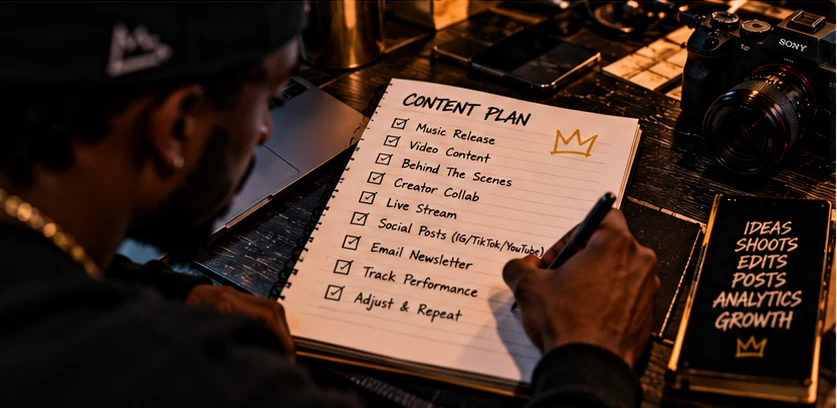
The PairOfDice Growth Loop
Create → Publish → Promote → Measure → Improve. Add your music or other creative work to your PairOfDice presence, share it with the community, track the engagement signals available to you, and apply what you learn to the next release. If you are developing an EPK, event, merchandise collection, or paid creative offering, connect your promotion to that next step instead of chasing impressions alone. Our creator tools and Creator Intelligence experience are being developed around helping creators make these decisions more effectively.
08
Build a Simple Weekly Analytics Routine
You do not need an analyst on your team or hours of spreadsheet work every day. Build a lightweight weekly ritual for your PairOfDice releases, creator profile, videos, and any relevant external platforms. Thirty focused minutes can be more useful than refreshing view counts all week.
Your 30-Minute Weekly Review
1
Review Your Goal
Start with the one outcome you chose for the month. Has the number moved in the right direction?
2
Compare With the Previous Period
Check the same metrics over comparable time windows. Note unusual campaigns, events, or releases.
3
Find the Strongest Signal
Identify the content, city, referral, offer, or audience segment that appears most promising.
4
Choose One Action
Decide what to create, test, improve, stop, or follow up on before your next review.
A Scorecard You Can Maintain in a Spreadsheet
GoalThe outcome you want this month or quarter.
Primary KPIThe main number that tells you whether the goal is being reached.
Supporting MetricsThree to five measurements that help explain the primary KPI.
Previous Period vs. Current PeriodComparable time windows showing movement, not isolated totals.
What ChangedNew release, collaboration, promotion, creative change, or external event.
Next ActionOne concrete decision with a date to review its effect.
Start Simple
Start with a simple spreadsheet or notes document. As your catalog and audience grow, use tools such as PairOfDice Creator Intelligence where they fit your workflow, and only automate reports once you know which numbers are genuinely useful.
A quarterly review can go deeper: evaluate your best audience sources, profitability, returning supporters, and the creative projects that deserve more investment.
09
Common Analytics Mistakes to Avoid
01
Chasing Vanity Metrics
A large follower count can look impressive without producing returning fans, genuine engagement, or sales.
02
Reacting to One Bad Day
Daily fluctuations are normal. Avoid overhauling your strategy before you have enough context.
03
Confusing Correlation With Cause
Two numbers moving together does not prove one caused the other. Promotions, timing, and outside events matter.
04
Ignoring Profit and Costs
Sales revenue and financial success are not the same thing. Account for production, fulfillment, platform, and marketing expenses.
05
Comparing Different Metrics
A Spotify listener is not the same as a YouTube viewer or a website visitor. Learn what each platform actually counts.
06
Collecting Data Without a Purpose
Avoid invasive tracking or collecting personal information you do not need. Respect consent, platform policies, and applicable privacy requirements.
Also avoid buying fake followers, streams, or engagement. Artificial activity distorts your analytics, damages your ability to make sound decisions, and may violate platform rules.
The Right Balance
Your audience is made of people, not just data points. Use patterns to inform your choices, and keep conversations, feedback, and creative intuition part of the decision.
Save This
Creator Analytics Checklist
Use this whenever you launch a new piece of content, release, campaign, or product.
- Write down one clear goal and the date you want to review it.
- Choose a primary KPI and no more than five supporting metrics.
- Record your baseline before a campaign begins.
- Check which platforms and reports actually provide the needed numbers.
- Use consistently tagged links where useful, and test your tracking.
- Compare similar content and comparable date ranges.
- Look for return visits, repeat listening, customer action, and loyalty.
- Include real revenue and costs when evaluating a commercial campaign.
- Keep a simple weekly scorecard and record your next action.
- Revisit your assumptions with direct audience feedback.
Final Thoughts
Stop collecting numbers. Start making better moves.
At PairOfDice Media, our goal is to help independent creators turn great work into real momentum. That starts with giving your music, videos, and other creative projects a place to be discovered and continues with understanding what actually connects with an audience.
You do not have to bend your identity to every algorithm. Publish work you believe in, invite people to discover it, study what happens, and improve the next step. PairOfDice creator profiles, releases, and our evolving creator tools can be part of that process, while your long-term relationships with fans remain the real asset.
Create with purpose. Learn from the numbers. Own your next move.
Ready to put this into practice? Discover PairOfDice creators, build your own creator presence, and explore the Creator Intelligence experience as you develop your growth strategy.